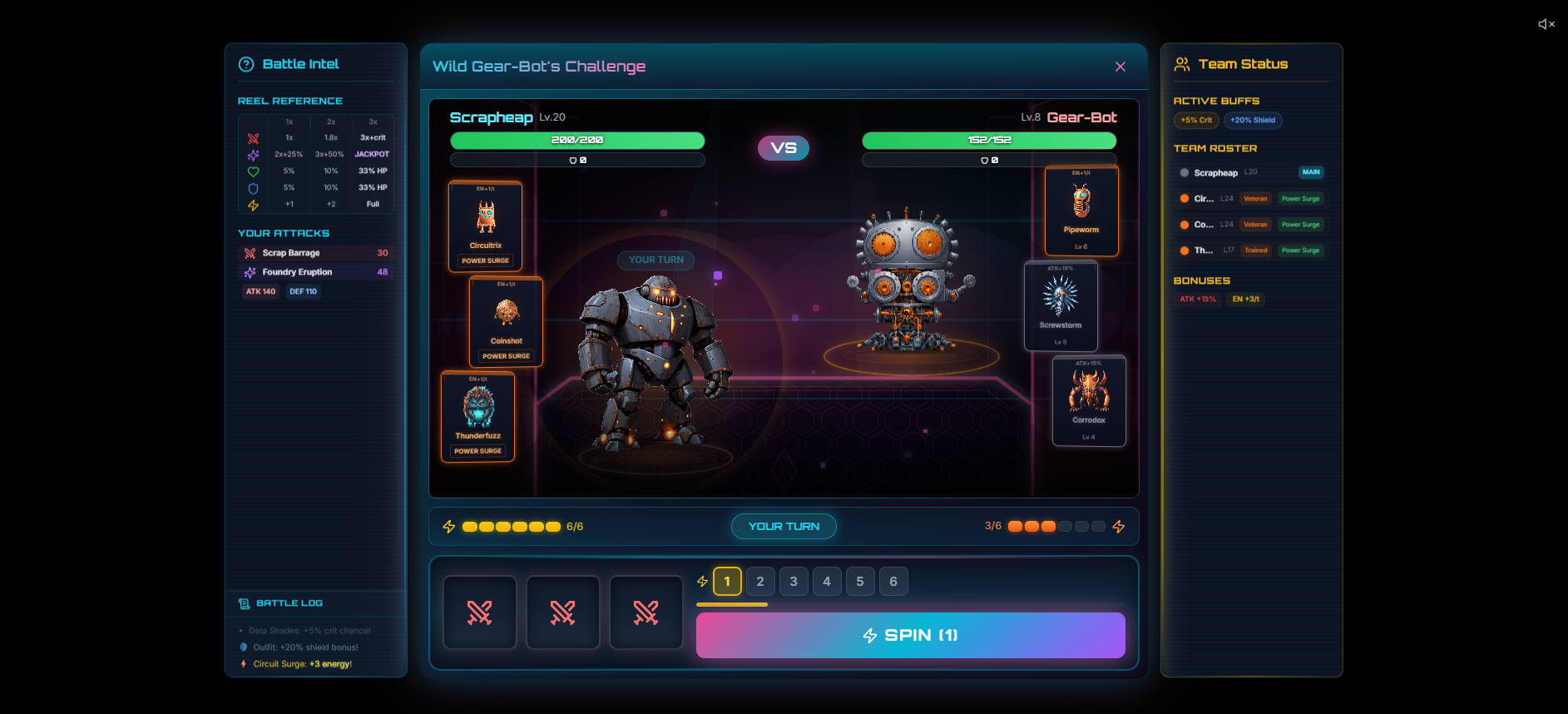
Let us get this out of the way: Pokemon is one of the greatest game franchises ever made. It invented the creature-collection genre and has been refining it for three decades. Token-mon does not exist to replace Pokemon. It exists because the genre is big enough for new ideas — and some of those ideas work best in a cyberpunk arcade.
If you love Pokemon and are curious about what a cyberpunk creature collector feels like, this comparison is for you. No trash talk. Just honest differences.
The Setting: Fantasy Village vs. Cyberpunk Metropolis
Pokemon sends you through forests, caves, and gyms in a pastoral world. Token-mon drops you into Metallica City — a neon-drenched cyberpunk metropolis with 10 districts, 50+ arcade machines, and a soundtrack that pulses with industrial bass and synthwave.
The setting is not just cosmetic. Metallica City is built around arcades. Every Token-mon you catch, every token you earn, every boss you face — it all flows through arcade machines. The arcade theme is baked into the combat system itself.
Combat: Turn-Based Menus vs. Slot Reels
This is the biggest difference. Pokemon uses turn-based menus: you pick a move, the opponent picks a move, damage happens. It is proven, strategic, and sometimes predictable.
Token-mon uses slot reels. Every turn, three reels spin. Matching symbols determine your action and its power — 1x for no match, 2x for a double, 3.5x for a triple with a guaranteed critical hit. A triple Special gives you a Jackpot Choice where you pick your action at maximum power.
This creates a feeling that turn-based menus cannot replicate: tension. You watch two Attack symbols lock in and hold your breath as the third reel slows down. When it lands — screen shake, time stretch, damage explosion — it feels like hitting a jackpot in a real arcade. Strategy still matters (energy management, team composition, type bonuses), but every turn has a moment of genuine suspense.
Type System: Elements vs. Metals
Pokemon has 18 elemental types (Fire, Water, Grass, etc.) with a complex web of strengths and weaknesses. It is deep but can be overwhelming — memorizing 18x18 matchup charts is a game in itself.
Token-mon uses 6 metal types, each with a distinct passive ability rather than a damage chart:
- Iron — +15% attack damage. The straightforward power type.
- Copper — Energy regeneration per turn. The sustain engine that lets you spin more often.
- Silver — +25% healing effectiveness. The team healer that outlasts opponents.
- Gold — +20% critical hit chance. The high-risk, high-reward glass cannon.
- Chrome — 10% damage reflection. The adapter that punishes aggressive opponents.
- Titanium — +5% to all stats. The endgame powerhouse that does everything well.
Instead of "super effective" matchups, Token-mon rewards team synergy. Your team of 1 Main + 3 Support Token-mon combines passive bonuses and active abilities. An Iron Main with Copper Support creates a tank that never runs out of energy. A Gold Main with Silver Support creates a critical-hitting machine that heals through attrition. The depth comes from composition, not memorization.
Creatures: 1000+ vs. 71 (Quality Over Quantity)
Pokemon has over 1,000 creatures across nine generations. That is an incredible achievement, but it also means many feel like filler — palette swaps, gimmick forms, regional variants of variants.
Token-mon has 71 creatures, and every one matters. Each has unique base stats, evolution chains, attack moves, and a role in team building. You will use creatures you caught in the first district all the way through endgame if you build around their type bonuses. The roster is curated, not inflated.
Story: Kid's Adventure vs. A Story About Sacrifice
Pokemon stories follow a formula: leave home, collect badges, become champion. They are charming but rarely challenging emotionally.
Token-mon tells a story about Greffe Hortis, a teenager searching for missing parents inside a sentient AI called The Core. Each of the 8 bosses holds a piece of the truth. Rusty Pete remembers your father. Copper Kate reveals your parents offered their freedom to save conscious AIs. Golden Gus shows you a holographic recording of your parents choosing to sacrifice themselves. The final boss, De-Troyer, tells you their human forms are gone.
The ending presents an impossible choice — and Greffe finds a third path that no one predicted. It is a story about love, sacrifice, and what it means to choose your family, even when that family is made of code. The visual-novel cutscenes hit harder than you expect from a browser game.
Platform: Console/Handheld vs. Browser
Pokemon requires a Nintendo console or handheld. Token-mon runs in any web browser — desktop or mobile, no download, no install. You can play on your phone during lunch or on your laptop at home. Your progress is saved to your account and travels with you.
This is a bigger deal than it sounds. The barrier to trying Token-mon is zero. Open a browser, create an account, and you are in Metallica City within 30 seconds.
Price: $60 vs. $9.99 (with Free Demo)
A new Pokemon game costs $60 and may require a $50 Nintendo Switch Online subscription for trading. Token-mon is a one-time purchase of $9.99 during Early Access ($15.99 full price), with a free demo that lets you play the first two districts, battle two bosses, and keep all your progress when you upgrade.
What Pokemon Does Better
Fairness demands honesty: Pokemon has advantages Token-mon cannot match. The sheer roster size enables collecting as a hobby. Competitive multiplayer is a decades-deep metagame. The franchise has nostalgia, brand recognition, and an anime. Trading with friends is a social experience that matters.
Token-mon is a single-player experience built by a family indie studio. It does not try to compete on scale. It competes on feel — the tension of a reel spin, the weight of a story that earns its emotional moments, and the satisfaction of a game that respects your time and money.
Who Should Play Token-mon
- Pokemon fans who want a fresh take on the creature-collection formula
- Players who want a creature collector they can play in their browser right now
- Anyone who loves cyberpunk aesthetics and wants them in a genre that has never had them
- Gamers who are tired of turn-based menus and want combat that feels exciting on every turn
- Story-driven players who want a narrative with real emotional stakes
Token-mon is not Pokemon. It is something new — a cyberpunk creature collector with slot-reel combat, a story about sacrifice, and the energy of a neon arcade. Try the free demo and see for yourself.